

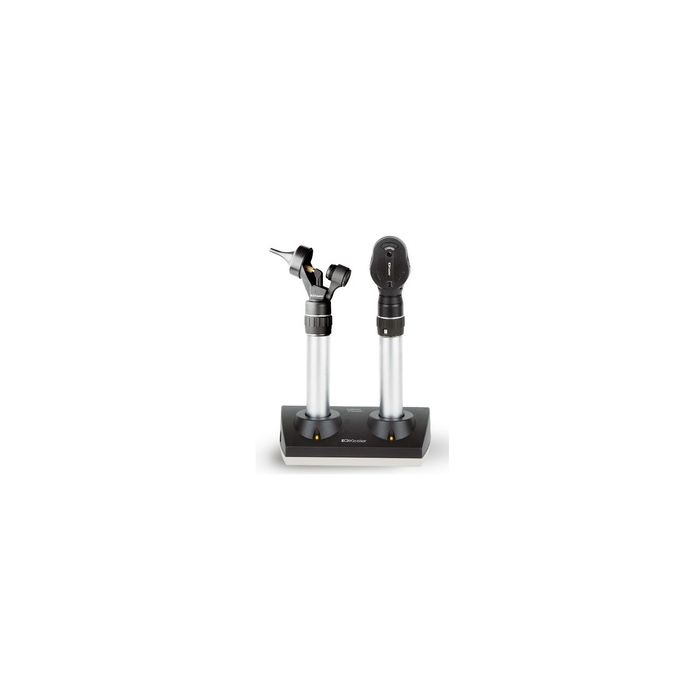
Otoscope and opthalmoscope set for vets
The rechargeable outfit consists of a standard ophthalmoscope, VetscopeB otoscope and double charging unit. The otosocpe opthalmoscope set can either be desk or wall mounted to suit your needs. The robust construction and larger specular make this diagnostic set ideal for vets and vetinary nurses.
3.6V Rechargable Lithium Battery Included. The Lithium-ion technology provides over 2 hours of continues use fromn a 2 hour rapid charge. LEDs indicate when battery is running low, chargning or fully charged.
Standard ophthalmoscope
The industry standard. An easy to use uncomplicated ophthalmoscope.
The positive action maywheel lens control allows vets to select lens powers from +40D to -25D.
- The opthalmascope provides two diagnostic beams:
- Wide angle - for general examinations
- Macula - for more detailed views
- Swing over Green, Red free, Filter
- The opthalmascope is designed for comfort with an integral soft brow rest
VetscopeB Otoscope
The Specially Designed Veterinary Practitioner's Instrument of Choice. An easy to use, reliable, Otoscope.
The Vetscope's purposeful design with larger soecula makes vetinary examinations significantly easier. The large otoscope ear specual allows easier examinations of animals of all shapes and sizes.
The open head system makes the otoscope suited for easy introdcution of small instruments for wax or foreign body removals. A large slide aside 2.5x lens creates a clear view of aural structures and procedures under magnification.
Can be used with either permanent or disposable specula. Facility to undertake otoscope pneumatic testing for tympanic mobility.
Who is this for?
For vets and vetinary nurses who are carrying out ear and throat examinations on a number of animals. Larger speculums allow for exams to be carried out on a range of animals.
FAQs
What is an opthalmoscope?
An opthalmoscope is a tool which allows vets, opticians and doctors to examine the inside of a patients eye. The opthalmoscope uses an angled mirror, leneses and a light source to see the patients retina, optic nve, retinal veins and arteries at the back of the eye.
How to use an opthalmoscope?
Get your patient to look straight ahead, turn the lights off, turn the opthalmoscope on and inspect both eyes looking at:
- Eyelids
- Eyes and pupils
- Pupil shape
- Pupil size
- Pupil colour
- Pupil symmetry
- Peri-orbital regions - tissue around they eyes
What is an otoscope?
An otoscope is a handheld instrument used by clinicians to examine the ears focusing on the ear canal and the eardrum (tympanic membrane). An otoscope will have a light source, a magnifying lens and disposable speculums.
How to use an otoscope?
Turning the otoscope on and applying a speculum and gently insert the otoscope in the patients ear. Move the instrument slowly to avoid unnecessary discomfort. Inspect the patients ear cancal for any
- Excessive ear wax
- Erythema and odema
- Discharge
- Foreign bodies
Next assess the eardrum for
- Colour
- Shape
- Light reflex
- Perforation
- Scarring
Finally remove the otoscope carefully before repeating the procedure on the oposite ear with a new sterile speculum.