
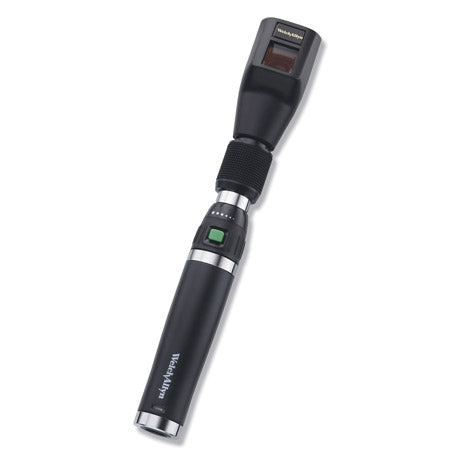
Welch Allyn Elite 3.5 V Halogen HPX Streak Retinoscope - Head Only - Power Handle Not Included
Welch Allyn Elite 3.5 V Halogen HPX Streak Retinoscope - Head Only - Power Handle Not Included
£566.99 ex.VAT
£566.99 ex.VAT
DIRECT ORDER - ESTIMATE: 15 Working Days
SKU: 18245 GTIN:00732094087734
Couldn't load pickup availability

Shipping
Shipping
FREE STANDARD SHIPPING available on all orders over £35 EX VAT (mainland UK only)
Next Working Day - available until 8pm Monday to Friday
Weekend Despatch - available until 12pm Sunday for MONDAY delivery (Next working day)
Saturday Delivery Service - available until 5pm Friday.
Why buy from Medisave?
Why buy from Medisave?
Medisave supplies health professionals, business and home users.
- Credit card, PayPal and Amazon Payments accepted
- Free delivery over £25 ex VAT
- NHS, school or company purchase order - email accounts@medisave.co.uk
- Laser engraving
- Delivery to private or commercial addresses
- Google Certified Shop
- Registered with the Medicines and Healthcare products Regulatory Agency (MHRA)
- ISO9001 quality management system + ISO 140001 environmental
- Established 1999
Need some advice? Speak to our friendly team on 0800 804 6447
Welch Allyn Elite 3.5 V Halogen HPX Streak Retinoscope - Head Only - Power Handle Not Included
Welch Allyn Elite streak retionscope makes refractions easier with one of the brightest, sharpest and cleanest streaks available. The Elite retionoscope has a compact design making it ideal for quick and clear assessments.
Hnadle not included.
Who is this for?
Ophthalmologists, optometrists, healthcare and eyecare professionals.
Features
- Light is 2.8x brighter than Welch Allyns standard retionscopes
- Crossed-linear polorising filter reduces glare from trial lenses
- External focusing sleeve offers continuous rotation of the streak during exams
- Fits all Welch Allyn 3.5V power sources
- Sealed optics help keep the retinoscope clean
FAQs
How to change the bulb in a Welch Allyn Retinoscope?
Separate the head from the handle, turning counterclockwise, remove the old lamp from the base of the head. Align the notch on the new bulb wit the slot inside the head and push it in making sure it snaps in place.
How to charge a Welch Allyn Retinoscope?
Plug the handle into the wall using a USB charger or place the handle in a charging well.
How to use a Welch Allyn Retinoscope?
Start by setting up your retinoscope by asking the patient to relax and look at a fixed point across the room. Dim the lights and sit an arms length away from them.
Begin with the retinoscope streak in a vertical position and direct the light into the patients right pupil, looking at the red reflex, before sweeping the retinoscope streak horizontally across the pupil. Rotate the retinoscope streak so it's horizontal and sweep across the pupil vertically. Repeat this with the retinoscope streak at a 45 degree and 135 degree angle.
Determine if the refractive error is spherical or astigmatic and the sphecrical compontent with various lenses roughly where a patients glasses would sit but keep the retinosope an arms distance away from the patient.
Double check the neutral point by observing reflex movement when moving forwards and backwards slightly at a normal working distance from the patinet. Finally look for refractive errors before performing the same examination on the left eye.